
Pelé and Building a Platform Behind a Global Legacy
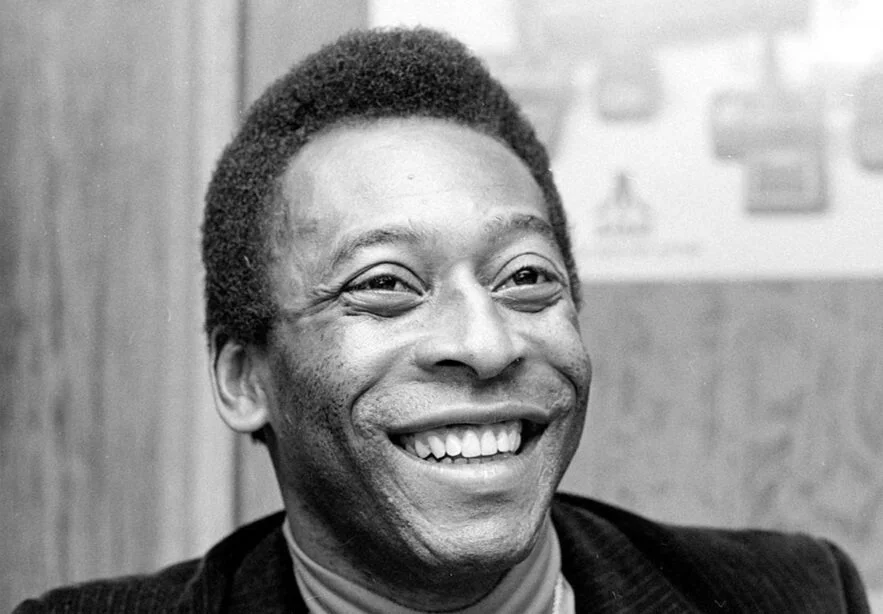
How Chris Flannery helped consolidate six decades of fragmented rights into a single global operation, and helped Pelé meet football's biggest event on his own terms.
At a glance
Rights consolidated: 4 entities → 1 owner
Footprint: 50+ countries and jurisdictions of commercial revenue
Capital raised: US$45M+ completed due diligence and transaction in 11 months
Commercial result: revenue more than doubled versus Pelé's prior World Cup cycle, with momentum sustained through the following Rio Olympics
A Global Stage, Six Decades in the Making
In 2010, Brazil stood at an inflection point. The country had just been awarded back-to-back hosting rights for two generational events: the 2014 FIFA World Cup and the 2016 Olympics. For Pelé, the footballer who had defined the sport for half a century, this was an opportunity six decades in the making. The world would be watching Brazil. The world would be watching him.
1966 Americas was brought in to make sure he was ready to meet it.
The opportunity was real, and so was the gap behind it. Pelé's name, image, and likeness, along with a six-decade archive of memorabilia, photography, and personal artifacts, were split across several entities, each managing a different slice of his legacy, each moving at its own pace. The infrastructure needed to capture a truly global moment, at global scale, simply didn't exist yet.
What followed was a two-part engagement: first, consolidating those fragmented rights under a single owner; then, building the commercial and cultural operation to put them to work. Here's how it came together.
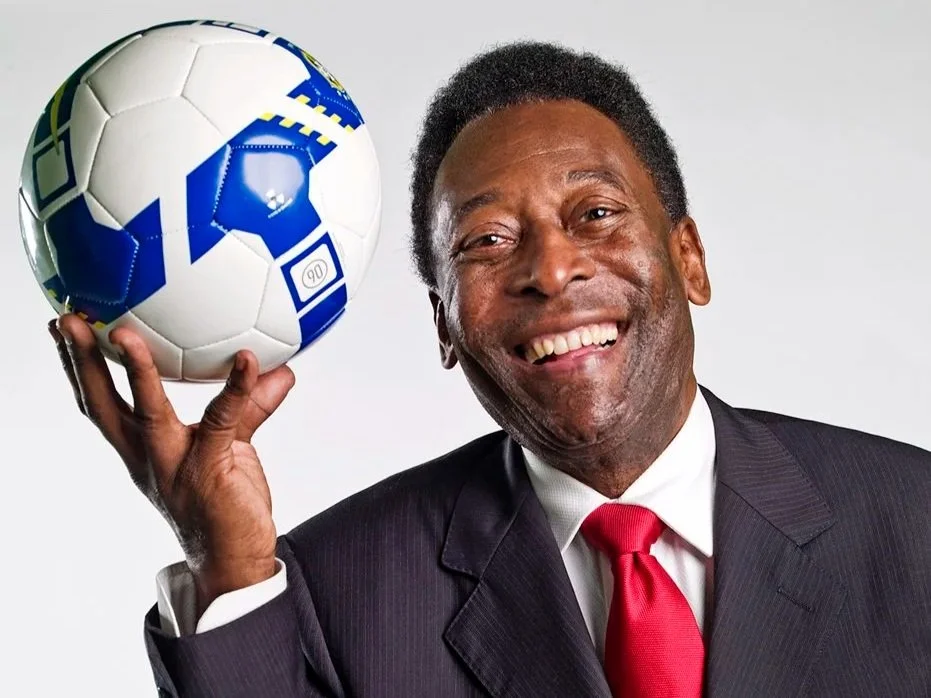
Rights Fragmented Across Four Stakeholders
Pelé's intellectual property, and the operation built up around it, was owned, controlled or managed by four separate entities. Each held a legitimate claim to their rights. Each operated toward different goals; their own.
The result was a familiar strain, if uncommon in scale:
Market confusion over who could approve a partnership, and on what terms
Slow-moving opportunities, stalled across multiple layers of approval
Mounting legal complexity, as contracts and permissions spread across more than 50 countries and as many jurisdictions
The deeper issue sat underneath all of it. Pelé's business infrastructure hadn't kept pace with his commercial potential, and closing that gap would take more than better coordination. It would mean rebuilding the rights themselves, and the operations built around them, from the ground up.
Rights Consolidation, Then a Global Operations Build
The engagement unfolded in two phases: consolidating ownership and rights, then building the operational infrastructure to put them to work at global scale.
Phase One: Consolidating Global IP Rights
The path forward was clear, if not simple. It meant mapping all the rights across every stakeholder and jurisdiction, raising the capital to acquire the major rights, bringing them under one roof within a tight window, and structuring a corporate entity able to manage international IP efficiently going forward.
Over US$45 million was raised. Eleven months went into diligence, negotiation, transaction execution, and corporate structuring. What emerged was a single, undisputed rights holder, the first Pelé's business had ever had.
Consolidation alone wasn't the finish line. A distributed structure leaves distributed loose ends: trademarks that needed re-registering region by region, an archive that had never been properly catalogued, deal terms inconsistent enough to slow down every negotiation. So remediation followed consolidation: an audit spanning more than 50 countries, trademark filings brought current market by market, and photographs, film, artifacts, and memorabilia organized into one coherent archive. Deal templates were standardized and approval workflows introduced, cutting partner turnaround from months to weeks.
With the foundation in order, attention turned to the commercial engine itself.
Phase Two: Building Global Management Operations
Across five regions, North America, Latin America, Asia, Africa and Europe, we identified, structured, and closed partnerships that would honor Pelé's legacy while building sustainable revenue. Chris Flannery created the corporate structure for the operation, including the management company Legends 10 that managed and represented Pelé’s commercial rights globally.
With rights secured and partnerships taking shape across all four regions, the work of building the brand itself could begin.
Building the Brand Platform
The first wave of commercial work centered on establishing Pelé as a brand partners could engage with confidently: structuring sponsorships with leading global names, building licensing frameworks that could scale from consumer products to entertainment, and expanding into content, media, and cultural appearances. Each partnership reinforced the next, building a commercial footprint broad enough to match his global stature.
But the most distinctive work wasn't about scale. It was about how his legacy got framed. For a figure who had transcended sport decades earlier, the partnerships carrying the most weight would be the ones that treated his life as art, cultural and social expression, not endorsement. While also creating a new digital profile across the emerging social media and digital media platforms around the world.
Exhibitions and Cultural Authority
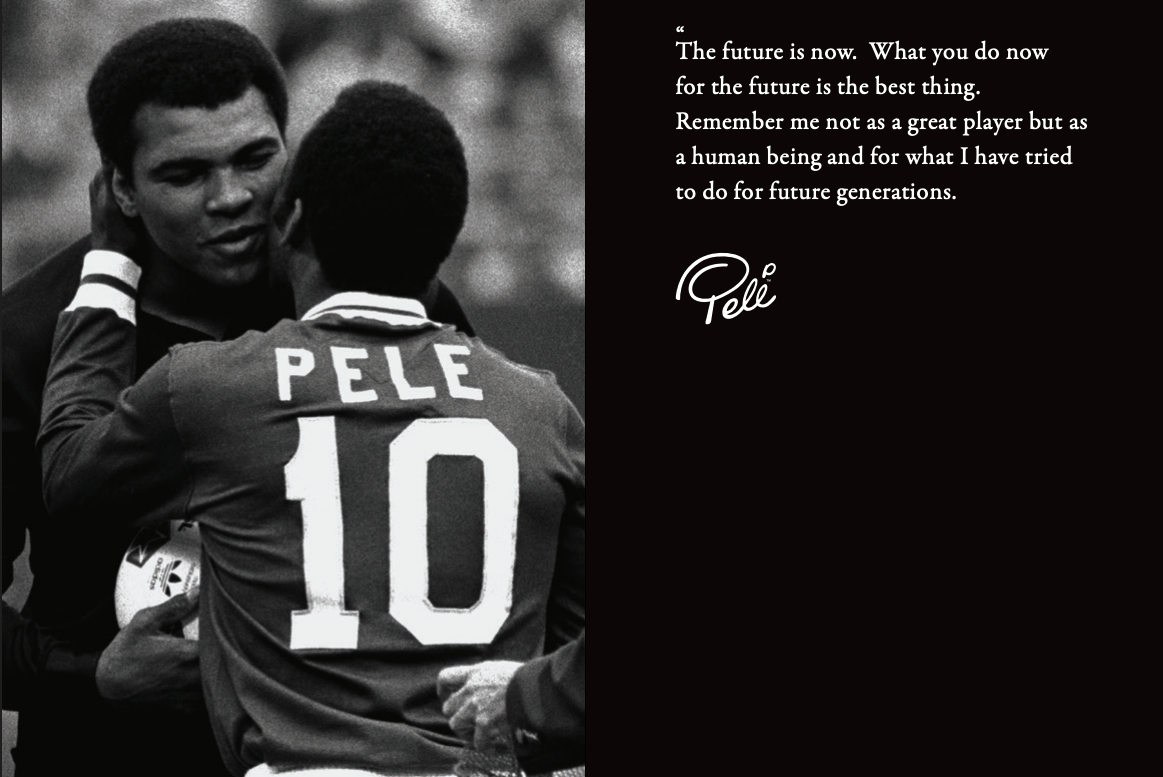
Pelé and Muhammad Ali embrace, 1977 Muhammad Ali Celebrity Sports Roast — two athletic icons whose influence extended far beyond their respective sports.
A major exhibition was commissioned to mark Pelé's 75th birthday in 2015 and six decades of achievement, bringing world-renowned artists together to honor his sporting career, his humanitarian work, and his standing as a cultural icon.
Its centerpiece was Andy Warhol's original 1977 portrait of Pelé, one of only ten works in Warhol's celebrated Athletes series. For the first time in decades, it was placed in dialogue with contemporary artists interpretations, including Lorenzo Quinn, Russell Young, and Pedro Paricio.
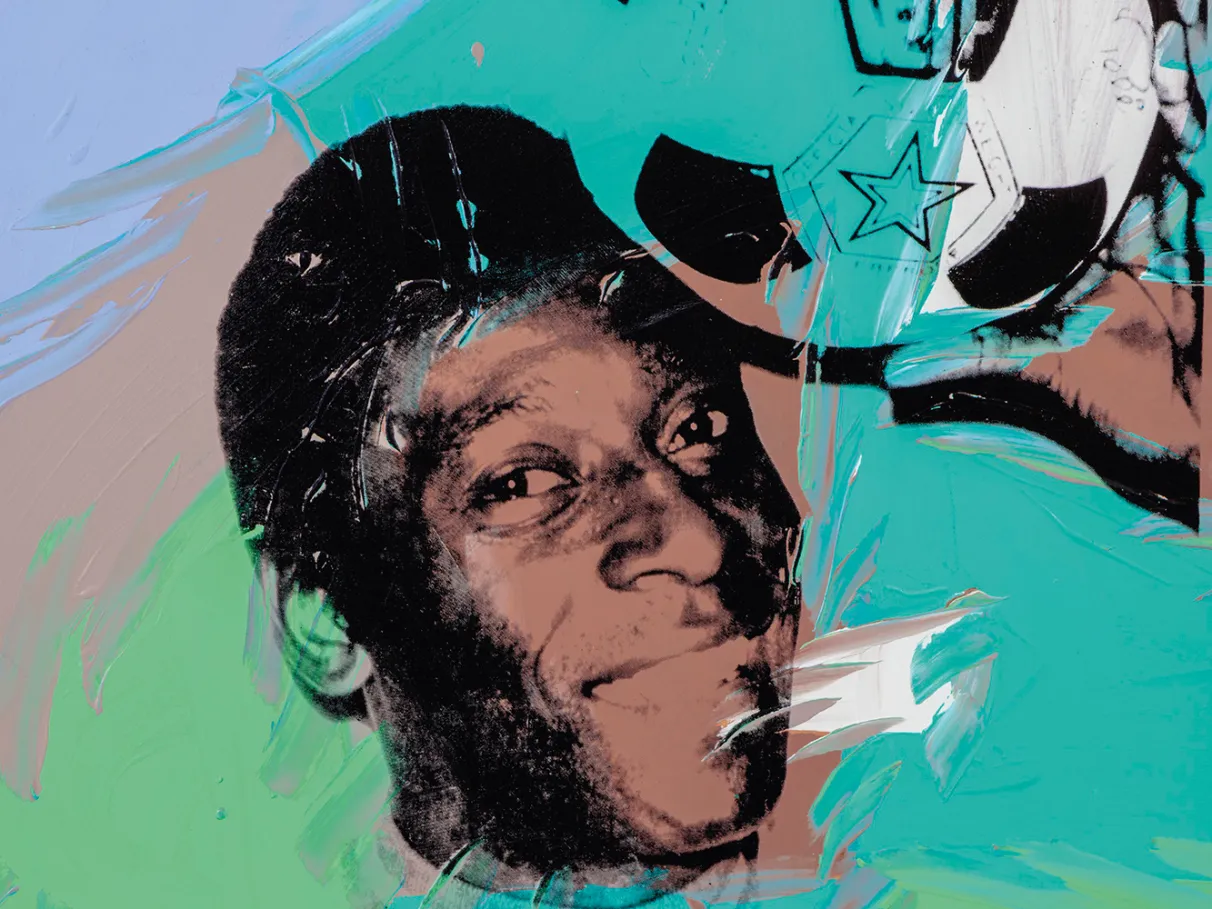
1977 portrait by Andy Warhol
Beyond the commissioned work, the exhibition included Pelé's own photos and paintings, alongside personal artifacts rarely seen outside Brazil. At the time, the statement it made was a quiet one: Pelé wasn't a historical figure to be archived. He was a living artist and a cultural force in his own right, a framing that still holds today.
The exhibition opened in Washington, DC, in 2013, in Santos/São Paulo in 2014 with the opening of the Pelé Museum, ahead of a full Halcyon Gallery presentation in London in 2015. Institutions took note. What had been built wasn't a merchandise showcase. It was a genuine cultural event, and it set the tone for everything that followed commercially.
Pelé: Art, Life, Football exhibition in 2015. Credit: Halcyon Gallery
Revenue Growth and Cultural Expansion
Commercial Performance
Revenue more than doubled against Pelé's best previous World Cup cycle performance, with momentum carrying through the 2016 Olympics, an unusual result given that most athlete campaigns peak around a single event and fade after.
Multi-national Partners included P&G, Volkswagen, Santander, Coca-Cola, Hublot, Emirates Airline and Subway, each engaged through strategic partnerships built to strengthen both Pelé's brand and their own market position, not simple licensing deals.
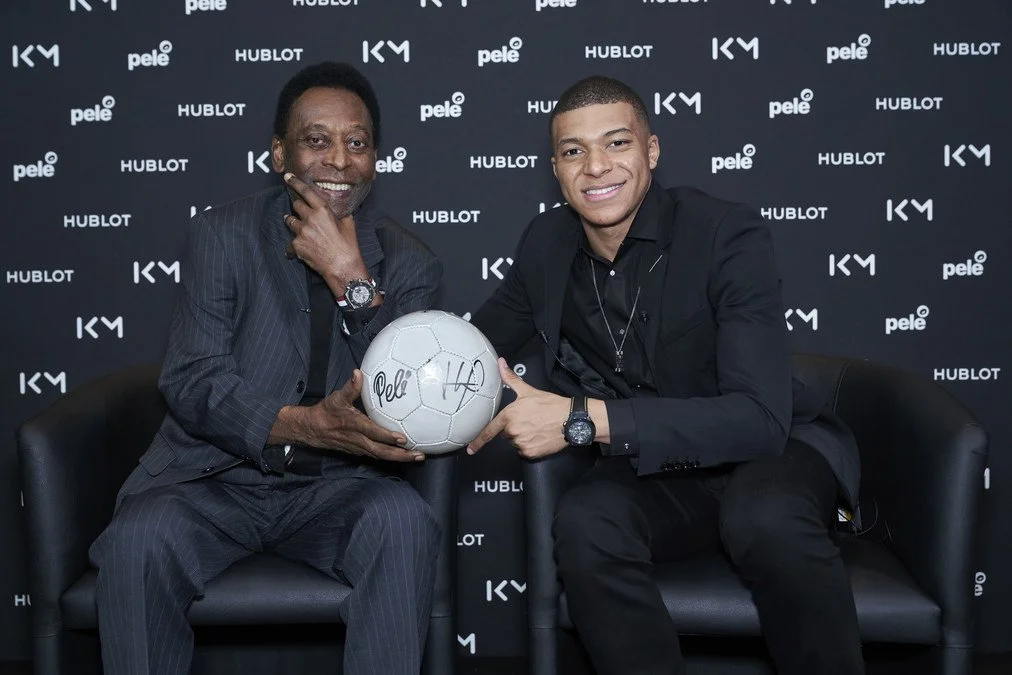
Pelé welcomes Kylian Mbappé as a new Hublot ambassador in Paris. Credit: Hublot, 2019
Cultural, Social and Legacy Initiatives
Beyond revenue, that commercial and cultural engine enabled a set of initiatives that reshaped Pelé's legacy for a new generation.
The Pelé Museum in Santos became a permanent home for his career and life, built less like a sports hall of fame and more like a cultural institution, where athletic achievement and artistic expression sit side by side.
Social programs and fundraising efforts for the Pelé Institute, part of Latin America’s largest Children’s Hospital at Pequeno Príncipe in Curitiba, Brazil. Initiatives with Coca-Cola in North Africa and a partnership with Shell to install the first-ever player-powered football pitch in the Morro da Mineira Favela in Rio de Janeiro.
The biopic, released in 2016, told his story for a global audience, a film only possible because the rights and infrastructure to manage a production at that scale already existed.
A global cultural presence grew naturally from this positioning: gallery exhibitions and major installations across multiple continents, appearances at prestigious sporting and cultural events worldwide, and a landmark 3-day tour in India where Pelé was honored at Legend's Night alongside cricket captain Sourav Ganguly and composer A.R. Rahman.
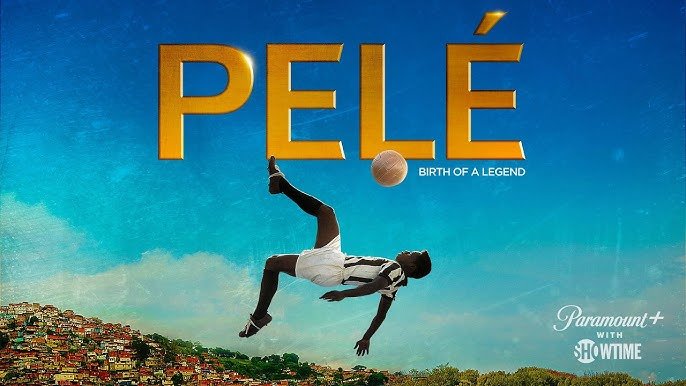
Pelé: Birth of a Legend by the Zimbalist brothers, 2016
The Principle at Work
Athlete intellectual property behaves like any other institutional asset. It demands clear ownership, fast decision-making, consistent valuation, and real operational structure.
Pelé had global recognition that no amount of marketing could manufacture. What he needed was an operation capable of converting that recognition into commercial velocity and cultural depth, built to sustain both well past a single tournament.
Key Takeaways for IP Consolidation
Clear ownership moves faster. A single, undisputed rights holder removes approval delays and creates consistent market positioning. Partners trust it, and pay a premium for it.
Cultural strategy expands commercial value. Positioning Pelé as a cultural figure, not simply an athlete, opened partnership categories and audiences that sports marketing alone would likely never have reached.
For athletes, entertainers, artists, or estate stewards with intellectual property worth protecting and expanding, this is something of a template.
The question was never whether Pelé's legacy was valuable. It's whether the infrastructure behind any legacy can capture that value over time.