Neymar Jr. and the Fifty-Year Question
How 1966 Americas helped one of football's most marketable stars build an original intellectual property platform designed to outlast his career.
At a glance
Marketability: SportsPro's most marketable athlete in the world, 2012 and 2013
Recognition: TIME 100 Most Influential People, 2017
Platform reach: Original comics launched across 6 language editions
International media coverage: Features include ESPN, The Sun, FOX Sports, Folha de São Paulo, ESPN Singapore, India.com, and MedioTiempo (Mexico)
A €222 Million Transfer, and a Different Kind of Question
In 2017, Neymar Jr. became the most expensive footballer in history, completing his transfer from FC Barcelona to Paris Saint-Germain for €222 million. At 25, he stood alongside Lionel Messi and Cristiano Ronaldo as one of the three defining players of his generation. SportsPro had already named him the world's most marketable athlete twice, in 2012 and 2013. Forbes tracked him among the highest-paid athletes anywhere, and in 2017, TIME included him among its 100 most influential people in the world.
None of that answered the harder question his team was already asking: what happens when the football ends?
Even at the top of the game, a playing career is short. Neymar's management wanted to start building businesses, intellectual property, and revenue streams around who he actually was, not just what he did on the pitch, while there was still a decade or more of playing time left to build on.
1966 Americas had faced a version of this question before, for another Brazilian icon whose career had also started at Santos FC. So the brief arrived framed as a single question: knowing how Pelé's commercial life had unfolded, what would 1966 Americas have told him at 25, to make the next fifty years matter?
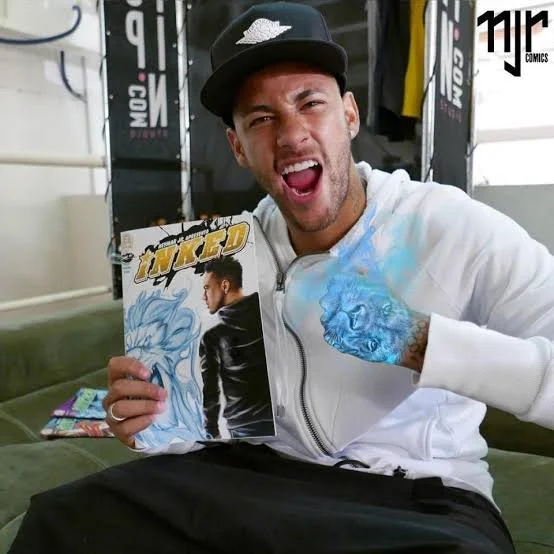
Neymar announcing the launch of his Inked comic series
Studying What Actually Lasts
Working alongside Neymar's management and advisors in Brazil, 1966 Americas took on the international side of a strategy built to run well past his playing career.
The starting point wasn't Neymar. It was the athletes who had already made the transition he was about to attempt — Pelé, David Beckham, Greg Norman, LeBron James, Michael Jordan, Cal Ripken Jr. — each of whom had built value around a brand, a body of work, or a business, independent of the career that made them famous in the first place.
Against that backdrop, 1966 Americas analyzed Neymar's global social audience to find where his interests ran beyond football, and matched that against what genuinely engaged him off the pitch. The work evaluated where the real opportunity sat — original content, digital distribution, gaming, livestreaming, and licensing categories capable of generating revenue for decades, not just headlines for a season — all without pulling focus from the football itself.
Four areas kept surfacing:
Comics and animation
Body art and tattoo culture
Gaming and livestreaming
Content development, production, and distribution
Between them, they mapped almost exactly onto who Neymar already was.
Building Neymar Jr. Comics
The strategy became Neymar Jr. Comics, a digital publishing platform built around original stories and characters drawn from Neymar's own interests, not licensed from someone else's universe.
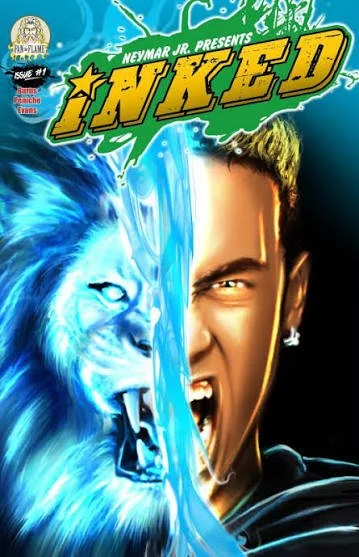
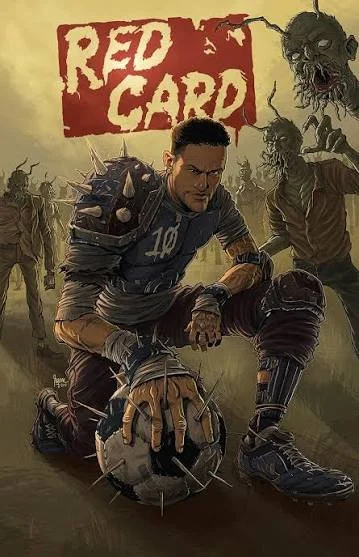
The first series, Inked: Art Animates Life, follows Junior, a Brazilian protagonist whose tattoos come to life and give him extraordinary power—Neymar's own history with comics and body art provides the authentic core of a fictional universe with room to grow into animation, gaming, and merchandise. Further concepts followed: a post-apocalyptic story built around a football-inspired survival game, and Golazo, a children's series weaving football, time travel, and moments from world history.
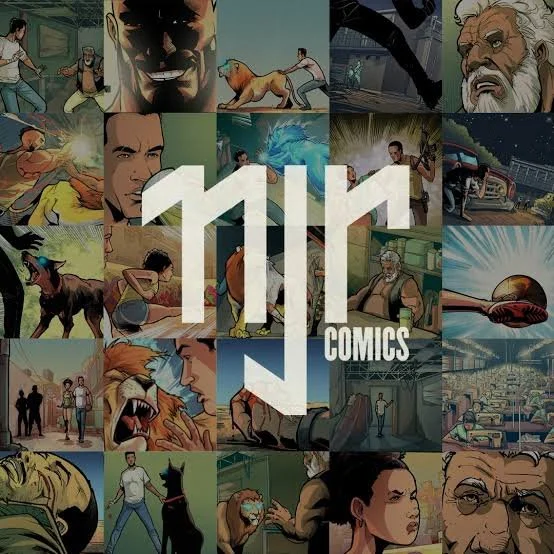
Neymar Jr. Comics brand identity featuring original characters
Inked launched across six language editions — English, Portuguese, French, Italian, and both European and Latin American Spanish — and was built to connect with the Instituto Projeto Neymar Jr. in Praia Grande, using the characters to support foreign-language education, with a share of future proceeds earmarked for the charity.
The launch made international news, including two dedicated features from ESPN, and even reached Mexico, India, and the UK. It was also showcased at New York Comic Con to an audience of hundreds of thousands. From there, the original IP expanded into licensing—temporary tattoos, skincare products, and mobile gaming.
The gaming strategy also carried Neymar onto Twitch, where his channel began with Counter-Strike: Global Offensive and grew to include other games and poker. He remains one of the most-followed footballers on the platform, giving him a direct line to a global gaming audience through something he was already doing for fun. In parallel, 1966 Americas worked with a major film and television production company on a slate of original concepts for digital and streaming distribution, spanning reality formats, unscripted documentary, and short-form programming for younger audiences.
Beyond Endorsements
Together, these initiatives gave Neymar something most athletes never build: an identity that doesn't depend on football to keep generating value. Rather than stacking up endorsements, the approach centered on original intellectual property, owned content, and platforms built to scale — the kind of asset that keeps producing cultural and commercial relevance during a playing career, and long after it ends.
Key Takeaways
Study the athletes who already made the leap. Jordan, Beckham, Ripken, and Pelé each built value that outlasted the career that made them famous — their playbooks are a starting point, not a template to copy.
Original IP compounds; endorsements don't. A licensed comic universe, once built, keeps generating licensing categories, content, and relevance long after the initial launch. An endorsement deal ends when the contract does.
Neymar was 25 when the strategy began. He had a decade of peak earning power ahead, a global audience in real time, and a narrow window to build intellectual property that would outlast the game itself. The best time to plan for what comes after isn't after—it's now, while the world is still watching. That's where the next fifty years begin.