
Moonshot and Building a New Vertical in Sports
How CTH Advisors and Chris Flannery, 1966 Americas CEO and Head of CTH's Advisory Practice, helped a national-security-grade threat intelligence company enter the sports market, turning a handful of early engagements into a defined and scalable business vertical.
At a glance
Targeted outreach: 43 qualified sports organizations approached directly
Pipeline: 19 presentations delivered and 7 proposals submitted against active client requirements
Revenue: 4 new client projects secured
Strategy: A structured, repeatable go-to-market platform for sports and entertainment
Why Moonshot Needed a Path Into Sports
Technology built for one world sometimes finds its next big opportunity in a very different one. That's what happened to Moonshot, a threat intelligence and online safety company that spent nearly a decade supporting government agencies responsible for protecting national institutions, public figures, and communities. Its unexpected new market was sports.
After Moonshot's CEO presented at a leading sports conference, the company saw a clear opening for its expertise. Athletes, officials, coaches, and executives were facing increasing levels of online abuse, and sports organizations needed better ways to tell offensive content apart from behavior that could escalate into a credible physical threat.
Moonshot's first sports work led to engagements with the Southeastern Conference (SEC) and the United States Olympic & Paralympic Committee (USOPC). These proved the technology was relevant, but they weren't yet a strategy. Making sports a real vertical would expand Moonshot's total addressable market, diversify its client base, and strengthen its long-term growth proposition, and that required a more systematic approach.
That's when one of Moonshot's lead investors introduced it to CTH Advisors, an advisory and investment banking firm that pairs seasoned dealmakers with veteran operators.
The Brief and the Team
The brief called for an integrated market-entry, strategic advisory, and business-development solution, led by Chris Flannery, CEO of 1966 Americas and Head of CTH's Advisory Practice.
Chris was joined by Andy Brusman from CTH's Investment Banking practice and sports executives Jonathan Schecter and Nate Walsh. Together, they covered three areas:
Market analysis: Research the competitive landscape, pricing models, customer requirements, and Moonshot's differentiated value proposition.
Go-to-market execution: Develop and implement a strategy for the sports and entertainment market, using CTH's network to reach qualified prospects and senior decision-makers.
Long-term advisory support: Help Moonshot establish the relationships, commercial proposition, and operating framework required to grow within the sector.
CTH began by working closely with Moonshot's leadership to understand its technology, service model, pricing, delivery capabilities, and capacity for growth, then analyzed the competitive environment, including available services, market positioning, pricing structures, customer needs, and the procurement processes used by major sports organizations.
The research established that Moonshot's proposition extended beyond conventional social media monitoring. Its principal value was the ability to identify patterns of concerning online behavior, assess the potential for escalation, and help clients take appropriate action when digital threats could result in reputational, psychological, or physical harm.
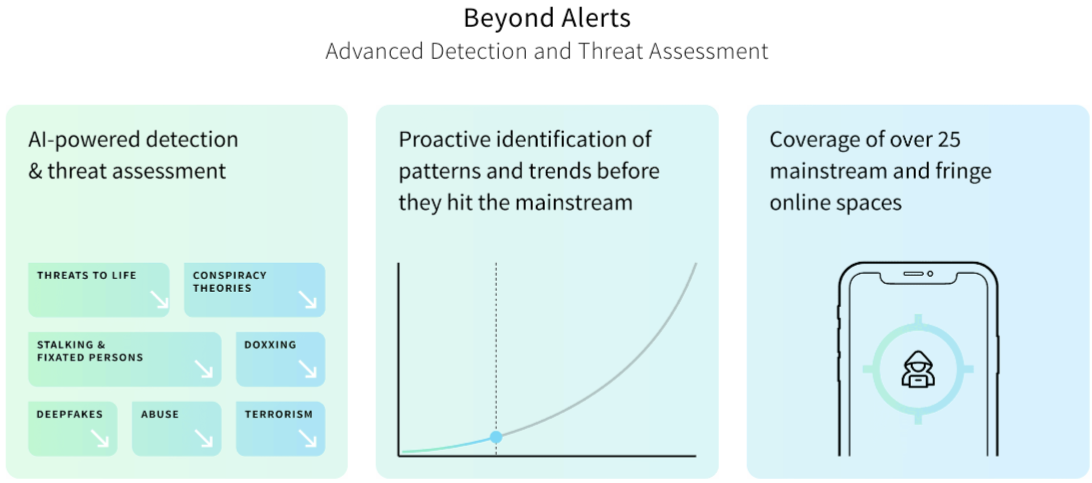
Monshot’s Advanced Detection and Threat Assessment solutions. (Image courtesy of Moonshot.)
Prioritizing Those Most at Risk
CTH developed a go-to-market strategy focused initially on the United States, with selective outreach to sports organizations in other English-speaking markets.
The strategy prioritized individuals and groups facing the greatest exposure to online abuse, including:
Female athletes and women working throughout sports
Athletes and communities frequently targeted by hate and harassment
Game and match officials
Coaches and team personnel
League, conference, and team executives
Administrators and governing-body leadership
High-profile athletes and their families
The rapid growth of sports betting was identified as an important contributor to the problem. Athletes, officials, coaches, and administrators were increasingly being personally targeted after individual plays, officiating decisions, or unfavorable results. Other areas of concern included stalking, doxxing, impersonation, coordinated harassment, and the misuse of artificial intelligence to create fabricated images or content.
Reaching the Right Decision-Makers
CTH created a multipronged business-development strategy addressing the principal buyers, influencers, and referral partners across sports:
Leagues, conferences, tours, and governing bodies
Professional teams, ownership groups, and major college athletic programs
Sports management agencies, athlete representatives, and player associations
Legal, risk-management, and physical-security companies
Individual athletes and other high-profile sports figures
Rather than relying on broad-based outreach, CTH identified the appropriate senior decision-makers within each target organization, led introductions, coordinated presentations, and helped Moonshot respond to active client requirements.
CTH also worked with Moonshot to translate a sophisticated threat-intelligence capability into a clear commercial proposition for sports executives, security teams, legal counsel, athlete-welfare professionals, and player representatives.
Outcomes
CTH's work established a structured commercial platform through which Moonshot could expand its sports and entertainment business.
The engagement produced the following results:
43 qualified sports organizations approached directly
19 presentations delivered to interested organizations
Engagement with leading professional leagues, teams, collegiate organizations, and sports management agencies
7 proposals submitted in response to active client requirements
4 new client projects secured
The work also demonstrated the real-world importance of Moonshot's technology. During research relating to a prominent athlete, Moonshot identified a pattern of threatening online behavior that was assessed as presenting a credible risk of physical harm. The intelligence was escalated to the appropriate authorities and contributed to a successful law-enforcement intervention.
The incident reinforced a central element of the market strategy: serious online abuse should not be treated solely as a social media, communications, or reputational issue. In certain circumstances, it is a security threat requiring specialist intelligence, professional assessment, and coordinated action.
Through its combination of market research, strategic positioning, senior-level access, and direct business-development execution, CTH helped Moonshot move from a small number of early sports engagements to a defined and scalable vertical-market strategy.
Key Takeaways
Positioning shapes the market. Presenting Moonshot as a security capability, rather than a social media monitoring tool, was central to the market strategy.
Targeted access beats broad outreach. Identifying senior decision-makers inside each organization and leading the introductions converted 43 targeted approaches into 19 presentations, 7 proposals, and 4 new clients.
Early wins need a system. The SEC and USOPC engagements proved the concept, but a structured strategy across leagues, teams, agencies, and security partners turned them into a scalable vertical.
Entering a specialized industry takes more than a great product. It takes the right positioning, the right introductions, and a partner who can turn strategy into revenue.